
For a chartered burial at sea, choose a water-designed biodegradable urn made from salt, sand, paper pulp, or plant fiber, and hold the ceremony at least three nautical miles offshore. Report the burial to the EPA within 30 days using the Burial at Sea Reporting Tool. Most charters can help you plan around both requirements.
TL;DR:
Biodegradable urns made from salt, sand, paper pulp, or plant fiber dissolve within minutes to a few hours, depending on material and water temperature.
The EPA requires burial at sea to occur at least three nautical miles offshore, with all materials fully decomposable and reported within 30 days using the official reporting tool.
Handling the urn on board should involve pre-boarding preparation, gentle lowering, and choosing the downwind side to ensure safety and respect during the ceremony.
Booking a private charter with an experienced captain allows for tailored timing, privacy, and assistance with EPA reporting, avoiding rushed or shared memorial services.
To minimize ecological impact, families should choose biodegradable materials for urns and flowers, avoid non-degradable items, and keep the ceremony simple and environmentally friendly.
Table of Contents
Which Biodegradable Urns Work Best for Ocean Burial?
The urn you choose shapes how the ceremony actually unfolds on the water, and not every “biodegradable” urn behaves the same way once it hits salt water. Some float for a minute or two, giving families a last visible moment before the urn softens and slips under. Others sink almost immediately and dissolve as they descend. Neither is more respectful than the other. It’s a matter of what your family wants to witness.
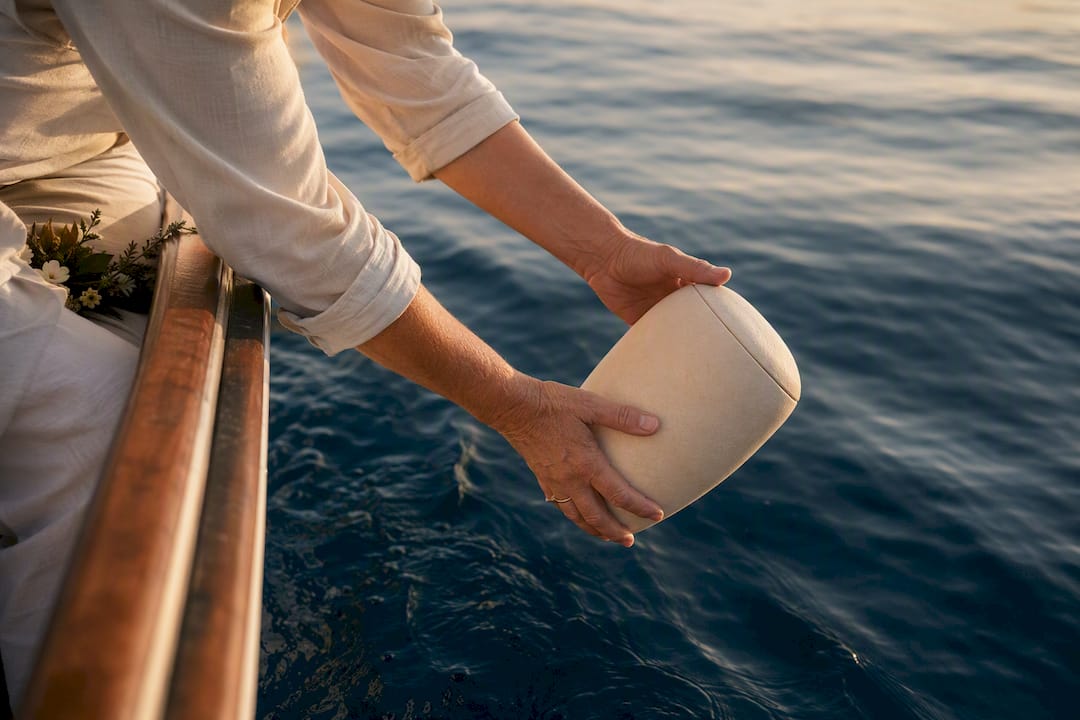
The most common materials for urns for ocean burial are compressed salt and sand, recycled paper pulp, compressed plant fiber, and gelatin-bound sand blends. Salt and sand urns tend to dissolve within minutes once fully submerged. Paper pulp and plant fiber versions can take anywhere from several minutes to a few hours, depending on wall thickness and water temperature.
That range matters for ceremony pacing. A fast-dissolving urn gives you a tight, focused moment. A slower one lets the boat linger a bit longer near the site, which some families prefer.
Materials that are never permitted include plastic, metal, glass, and coated or sealed wood, since none of these decompose in the marine environment. A biodegradable cremation urn has to be readily consumed by seawater, not just labeled “eco-friendly.”
A few practical notes worth knowing before you order:
-
Water soluble urns for ashes typically run in the $30 to $200 range depending on material and craftsmanship.
-
Paper pulp and plant fiber urns are lightweight but genuinely fragile. Handle them like an egg, not a keepsake box.
-
Order early. Some styles are handmade and can take one to two weeks to ship.
-
Ask whether the urn ships in a rigid outer box. That packaging protects the urn on the drive to the marina.
Pro Tip: Order the urn at least two weeks before your charter date, and keep it in its shipping box until the morning of the ceremony. Humidity and handling are the two biggest threats to a paper pulp urn’s structural integrity.
What Does Federal Law Require for a Sea Burial?
Federal rules for burial at sea aren’t a courtesy. They’re binding, and every charter operator is expected to follow them. The EPA’s burial at sea guidance sets the framework, and the specific distance and material requirements come straight from 40 CFR §229.1, the regulation codifying the Marine Protection, Research, and Sanctuaries Act.
Three rules govern nearly every private ceremony:
-
Cremated remains must be placed at least three nautical miles from land, with no exceptions for calm weather or short trips.
-
The urn and any tributes released with it must be readily decomposable. Plastic, metal, glass, and similar materials are prohibited outright.
-
The person who conducts the burial must report it to the EPA within a month, including the date, GPS coordinates, and a description of what was placed in the water.
That reporting requirement is a firm obligation, applying regardless of whether the ceremony was arranged through a funeral home or a private charter captain.
The EPA’s Burial at Sea Reporting Tool makes filing straightforward. You can submit as a guest for a single report, or set up an account if you expect to handle multiple burials over time. The tool asks for the vessel name, coordinates, date, and materials released. Most families never touch the form themselves. Their captain files it as part of the service.
How Do You Handle the Urn Safely on Board?
A biodegradable urn is not built for rough handling, and a moving boat is the worst possible place to discover that. The safest approach follows a simple sequence, worked out over years of captains guiding families through this exact moment.
-
Prepare the urn on land, before you board. Seal it, wrap it in its protective packaging, and place it in a bag or box that won’t shift. Never open or repack the urn once the boat is underway.
-
Assign one person who isn’t in mourning to manage logistics. This “steady person” carries the urn, coordinates with the captain, and handles timing, freeing immediate family to simply be present.
-
Choose the downwind side of the vessel for the release. Wind direction matters more than most families expect. Releasing into the wind can blow ash or debris back onto the deck.
-
Lower the urn gently into the water rather than tossing it. A short drop from a stable stance is enough. Height adds risk without adding meaning.
-
Watch and wait. Some urns float briefly before softening; others sink right away. Either behavior is normal, and the captain will typically hold position until the urn is out of sight.
The captain’s job during all of this is bigger than steering. A USCG-certified captain stops the vessel at the compliant site, records the exact GPS coordinates, and keeps everyone steady on deck, literally and emotionally, during a moment that deserves full attention rather than divided focus.
Pro Tip: Ask your captain, before the day arrives, whether they’ll narrate the moment or stay quiet. Some families want a few words spoken over the water; others prefer silence. Saying so in advance spares everyone an awkward beat at the worst possible time.
What Should You Ask Before Booking a Charter?
A short checklist, worked through a week or two before the ceremony, prevents almost every last-minute scramble families run into.
Before you book, ask the charter directly:
-
Do you assist with EPA reporting, or should we plan to file it ourselves?
-
How many years has the captain been running memorial charters specifically?
-
What’s the maximum number of guests the vessel allows?
-
Is there flexibility if weather forces a rescheduling?
-
Is an unattended scattering option available for guests who can’t be present?
On the day itself, bring:
-
The cremation certificate (some marinas or harbor authorities may ask to see it).
-
The urn, sealed inside its protective box, kept upright during transport.
-
A phone with GPS enabled, as a backup to the vessel’s own navigation log.
-
A short contact list for anyone who wants updates or photos afterward.
Build in a weather buffer. Ocean conditions three miles out can differ sharply from what you see at the dock, and a good charter will offer to reschedule rather than push through rough water. If your family wants to keep a small portion of ashes as a keepsake, mention that when booking. Most captains can accommodate a split urn or a separate keepsake vial without disrupting the ceremony.
How Do You Minimize the Ecological Impact of a Sea Burial?
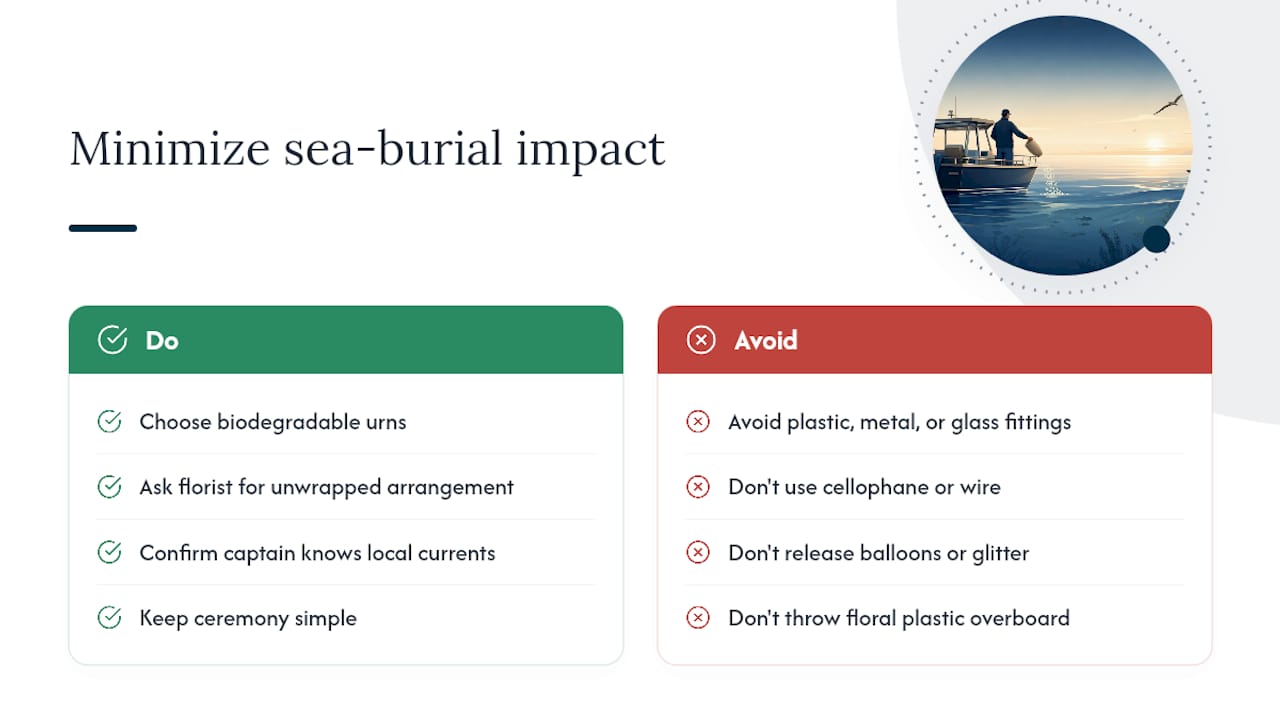
A respectful burial at sea leaves the water essentially undisturbed once the ceremony ends, and that outcome depends on choices made well before the boat leaves the dock. The biggest lever is material selection: an urn built from salt, sand, or plant fiber breaks down naturally and introduces nothing foreign into the marine food chain. Anything with a plastic liner, metal fitting, or glass component does the opposite, which is exactly why federal rules bar those materials outright.
Flowers deserve the same scrutiny. Loose petals from real flowers generally decompose without issue, but bouquets wrapped in cellophane, held together with wire, or dyed with synthetic colorants can leave lingering debris. If your family plans a floral tribute, ask the florist for an unwrapped, wire-free arrangement, and confirm with your captain that whole plastic wrapping stays on the boat.
Timing also plays a quiet role. Captains who know local currents and wildlife patterns can position the vessel to avoid sensitive habitat and reduce the odds of debris drifting toward shore. That local knowledge is one of the more overlooked benefits of chartering with an experienced operator rather than treating the location as an afterthought.
Keep the ceremony itself simple. Balloons, glitter, and non-biodegradable confetti are common at memorial services but do real harm in open water, and most charters will ask you to leave them at the dock.
Are There Alternatives to Biodegradable Urns for Sea Burial?
Families sometimes ask whether scattering loose ashes directly from the boat is simpler than using an urn, and it is legal under the same EPA framework. But most charter captains and grief specialists note that families tend to prefer a water-designed urn over loose scattering because it gives the ceremony a clear focal point and avoids the wind carrying ash back onto the deck or guests.
Loose scattering does have one advantage: it costs nothing beyond the charter itself, since there’s no urn to purchase. The tradeoff is control. Wind direction has to be nearly perfect, and the moment can feel less contained than watching a single object enter the water and disappear.
A second alternative is a reef ball or living memorial, where cremated remains are mixed into a concrete structure designed to support coral growth. These require working with specialized reef memorial companies rather than a standard charter, involve a longer lead time, and are typically arranged separately from the day-of ceremony.
Non-cremated remains follow a different, stricter set of depth and preparation requirements under the same regulation and generally require working with a licensed provider rather than a private charter. For nearly every family planning a private ceremony, though, a biodegradable cremation urn remains the simplest option that satisfies EPA rules while giving the moment real ceremonial weight.
How Long Does the Whole Process Take?
Planning a burial at sea moves faster than most families expect once the urn is ordered. The urn itself is usually the long pole. Expect one to two weeks for production and shipping if you’re choosing a custom or handmade design, though simpler salt and sand urns can sometimes ship within days.
Booking the charter itself can happen in parallel. Most operators need anywhere from a few days to two weeks of lead time, though weekends and peak seasons fill faster. The ceremony on the water is typically brief: reaching the three nautical mile boundary takes 20 to 40 minutes depending on the vessel and starting point, and the release itself takes only a few minutes once everyone is positioned and ready.
The reporting step is the part families most often forget, because it happens after the emotional weight of the day has passed. The EPA gives a 30-day window to file, and most charters that offer this service handle it within a few days of the ceremony while the coordinates and details are still fresh.
All told, a family working roughly two weeks ahead of a chosen date, urn ordered promptly and charter booked early, can expect a smooth timeline from planning through filing, without the scramble that comes from waiting until the week of.
Do You Need a Permit for a Burial at Sea?
Burial at sea for cremated remains doesn’t require an individual permit the way many families assume. It falls under a general permit issued through the Marine Protection, Research, and Sanctuaries Act, which means the requirements are the rules themselves: stay at least three nautical miles offshore, use only decomposable materials, and file the EPA report within 30 days.
There’s no application to submit before the ceremony and no waiting period for approval. The obligation is on the back end: reporting after the fact rather than requesting permission beforehand. That’s a meaningful distinction, because it means a family working with an experienced charter can typically move from decision to ceremony within a couple of weeks, rather than waiting on a bureaucratic approval process.
Where families sometimes get tripped up is assuming a funeral home or crematorium handles the reporting automatically. It doesn’t happen unless someone, whether that’s the family or the charter operator, actually files it. Confirm this explicitly when booking. Ask directly: “Who is filing the EPA report, and when?” A charter that has done this before will have a clear answer.
The one situation requiring more than the general permit involves non-cremated remains, which fall under stricter depth and site conditions and generally require coordination with a specialized provider rather than a standard private charter.
What a Family Can Expect From a Private Charter Ceremony
Grief doesn’t organize itself around paperwork, but the paperwork still has to happen, and that’s where a good captain earns their keep. On a burial at sea aboard the Mojave, the process usually looks the same regardless of the family: navigate to a compliant site at least three nautical miles out, stop the vessel, help position everyone for the release, record the GPS coordinates, and offer to handle the EPA filing afterward so the family doesn’t have to think about it during the week that follows.
What a private charter adds that a larger group tour can’t is control over the moment itself. There’s no schedule to share with strangers, no rushing because another party is waiting for the boat. A USCG-certified captain and a small, private vessel mean the ceremony moves at the family’s pace, whether that’s five quiet minutes or a slower hour on the water afterward. Families consistently describe that privacy as the difference between a service and an actual farewell.
— David
Book a Private Burial at Sea With Sterlingsails
Sterlingsails offers a private burial at sea charter aboard the Mojave, a genuine alternative to sharing a memorial cruise with strangers on a larger group vessel. Every ceremony is arranged for your family alone, with a USCG-certified captain who navigates to a compliant site, helps position everyone for the release, records the GPS coordinates, and can assist with the EPA report so you’re not left filing paperwork during a difficult week.
Charters can be shaped around what your family needs: a short, focused release, or a longer voyage that leaves time to sit quietly on the water afterward. Keepsake urns, additional passengers, and flexible timing are all things you can discuss directly with your captain rather than choosing from a rigid package. If you’re weighing charter length or want to see other private sailing options first, the full sailing adventures lineup shows what’s available beyond the ceremony itself.
To move forward, reach out through the burial at sea page to check available dates and talk through what your family has in mind. A private ceremony, planned around your timeline, is one booking away.
Sources
FAQ
How far offshore must a burial at sea take place?
Cremated remains must be placed at least 3 nautical miles from land, a requirement set by 40 CFR §229.1 and enforced through EPA guidance.
What materials are biodegradable urns for ash scattering made from?
Common materials include compressed salt and sand, recycled paper pulp, and compressed plant fiber, all of which dissolve naturally in seawater within minutes to a few hours.
Do I have to report a burial at sea to the EPA?
Yes. Federal rules require reporting within 30 days of the ceremony, including the date, GPS coordinates, and materials used, filed through the Burial at Sea Reporting Tool.
Does Sterlingsails help with EPA reporting for a burial at sea?
Sterlingsails’ burial at sea charter can assist with recording GPS coordinates and offers to help with EPA reporting so families aren’t left handling it alone.
What’s the difference between sea scattering vs. a funeral service?
A funeral service is typically land-based with burial or interment, while a sea burial or scattering happens aboard a vessel at least 3 nautical miles offshore and follows separate EPA reporting rules.