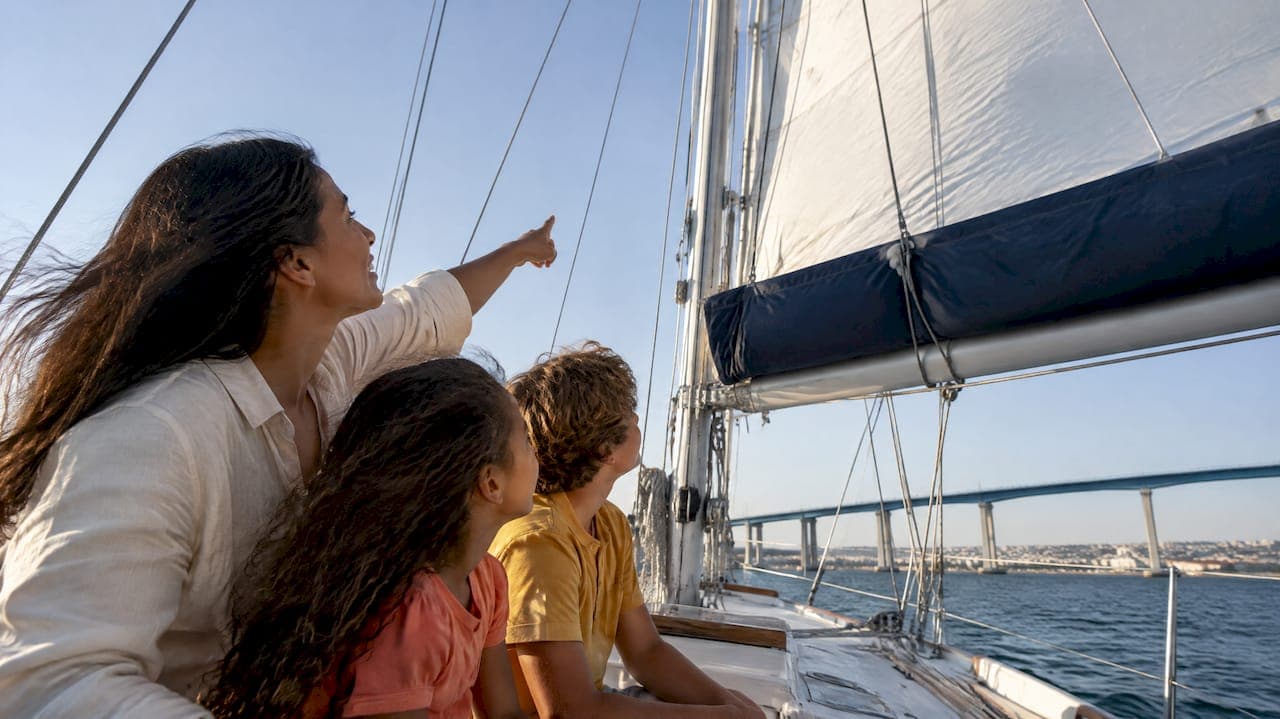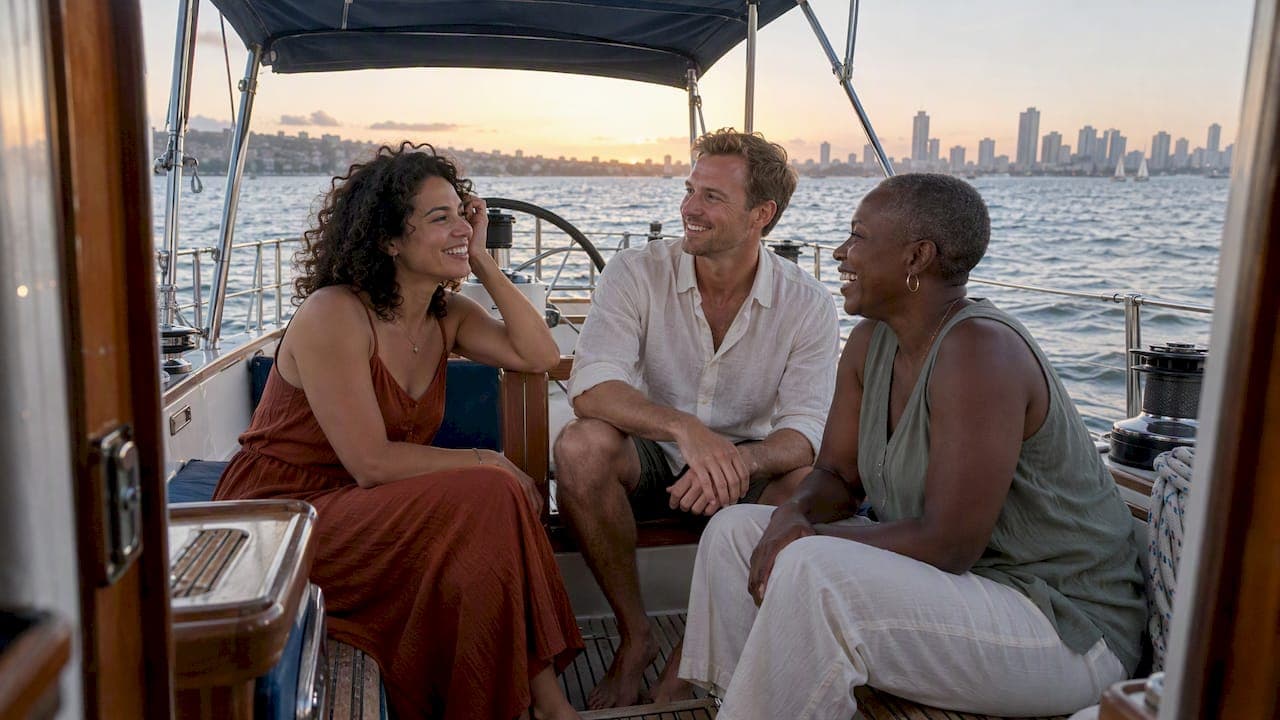

Scattering ashes in San Diego is legal, on the water and in select public spaces, as long as you follow California and federal rules. Start by getting the Permit for Disposition of Human Remains (VS-9) from the county, or confirm in writing that your charter or funeral provider will file it for you. If you’re heading offshore, know the distance requirements before you leave the dock. Report to the EPA if federal rules apply.
TL;DR:
A county-issued VS-9 permit and appropriate paperwork are mandatory for all ash scatterings in San Diego, with filing deadlines of ten days for county reports and thirty days for federal reports if applicable.
Common scattering locations include offshore waters near Point Loma, Shelter Island, and Coronado, with shore-viewing permitted but scattering strictly on water, avoiding federal park land restrictions.
Private charters range from mid-hundreds to thousands of dollars, depending on vessel size, duration, and personalization, with unattended services costing in the low hundreds.
Biodegradable urns or scattering tubes are recommended for environmental safety, with careful attention to wind direction and distance from shore to ensure respectful, eco-friendly ceremonies.
Confirming permit handling, vessel credentials, and weather policies in advance helps families avoid logistical issues on the day of the ceremony.
Table of Contents
-
Attended Charters, Unattended Services, and Shore-Viewing Compared
-
Environmental Concerns and Eco-Friendly Scattering Practices
-
Scattering Gardens, Memorial Parks, and Land-Based Alternatives
-
Cultural and Religious Customs Families Bring to the Ceremony
-
Preparing Ashes: Urn Choices and Handling Before the Ceremony
Where You Can Legally Scatter Ashes in San Diego
California doesn’t let you scatter ashes from a pier, boardwalk, or the shoreline itself. The remains have to leave from a vessel, and the state’s own scattering guidance points families toward open water rather than the sand. Most local operators plan a route that clears roughly 500 yards from shore to satisfy state expectations, then factor in federal thresholds if the trip pushes further out.
San Diego families tend to gravitate toward a handful of spots:
-
Point Loma offshore waters, where the coastline drops away and the water opens up past the kelp beds.
-
Shelter Island and Harbor Island, the boarding points most charters and sportfishing outfits use, including H&M Landing.
-
Views toward Coronado, often chosen for the skyline backdrop rather than as a scattering site itself.
If a boat trip isn’t right for your family, watching from shore near these same areas is legal and common. Just remember the scattering itself has to happen on the water. National Park Service land, including Cabrillo National Monument, carries its own restrictions on memorial gatherings, so check before planning anything on federal park property.
Permits and Paperwork: Getting the VS-9 Filed Correctly
The Permit for Disposition of Human Remains, known as the VS-9, is required for every scattering in San Diego County, whether it happens on land or at sea. The county’s Office of Vital Records issues it at the counter for a $12 fee, and you’ll need a death certificate or a state transit permit on hand to get it processed.
Pro Tip: Ask your funeral home or charter operator directly whether they handle the VS-9 filing, or if that responsibility falls to you. Get the answer in writing before the ceremony date, not after.
Here’s the sequence most families follow:
-
Request the VS-9 from the county office, in person or by mail, using the death certificate or transit permit as backup documentation.
-
Complete the scattering.
-
File a verified statement with the county within 10 days confirming the scattering occurred, including GPS coordinates when available.
-
If the scattering happens far enough offshore to trigger federal rules, submit an EPA burial-at-sea report within 30 days.
That 10-day county window and 30-day EPA window are easy to miss during an already emotional stretch, which is exactly why confirming who’s responsible for filing matters as much as the ceremony itself.
Attended Charters, Unattended Services, and Shore-Viewing Compared
Families generally choose between three approaches, each with different logistics and a different outcome.
-
Attended private charters put you and your group on the water with a USCG-certified captain. You’re present for the ceremony, and the crew typically hands you GPS coordinates and a memorial certificate afterward.
-
Unattended scattering services have a boat operator perform the ceremony without family aboard, then send documentation, coordinates, sometimes photos, confirming it was done.
-
Shore-viewing lets family watch from Shelter Island, Harbor Island, or Point Loma while a smaller vessel or the same charter handles the actual scattering just offshore.
Pro Tip: Before booking anything, ask the operator four questions: who files the county and EPA paperwork, what USCG certification the captain holds, what happens if weather forces a reschedule, and how many guests the vessel can safely carry.
Local providers note that families lean toward unattended services for convenience and toward attended charters when they want a private, personalized farewell rather than a documented transaction.
What San Diego Ash Scattering Actually Costs
Budget depends almost entirely on whether you want to be there. Unattended scattering services in San Diego often start in the low hundreds of dollars, since there’s no vessel time for guests and no ceremony to coordinate around a group’s schedule.
Private attended charters run higher, generally mid-hundreds to low thousands, depending on vessel size, duration, and how much personalization you want built in. Most ceremonies run about 1.5 to 2 hours dock to dock, enough time to get out to open water, hold the ceremony, and return without rushing.
A few things that add to the total:
-
Biodegradable urns or scattering tubes, if you don’t already have one.
-
Extra time on the water beyond the standard ceremony window.
-
Military honors or flag-folding for veterans.
Popular weekend dates fill fast, especially in spring and fall, so book several weeks out and ask about the operator’s weather rescheduling policy up front.
Your Pre-Booking Checklist for a San Diego Scattering
Before you commit to a date, confirm these items so nothing gets discovered the morning of the ceremony:
-
Permit status. Has the VS-9 been issued, and does someone have a physical or digital copy to bring aboard?
-
Documentation. Do you have the death certificate or transit permit the county requires to issue the permit?
-
Filing responsibility. Who submits the county’s 10-day statement and the EPA’s 30-day report, if it applies?
-
Vessel and captain credentials. Is the captain USCG-certified, and does the vessel meet passenger safety limits for your group size?
-
Urn guidance. Does the operator require or recommend a biodegradable urn, and do they supply one?
-
Timing. When should ashes be delivered before departure, and what should the family bring the day of?
Ask a potential operator each question directly rather than assuming it’s covered. A provider who answers all six without hesitation is one who’s done this before.
How a Private San Diego Memorial at Sea Actually Works
Sterling Sails runs burial-at-sea charters aboard Mojave, a classic yacht based on San Diego Bay, with a USCG-certified captain and a fully private booking, no strangers, no shared schedule. Families receive GPS coordinates marking the exact scattering location along with a memorial certificate once the ceremony concludes.
Personalization is where a private charter earns its keep. Families have built ceremonies around a favorite song played as the ashes leave the boat, a reading from a grandchild, biodegradable flower petals scattered alongside the ashes, and formal honors for veterans. Guests who prefer to stay on land can still watch from shore near Shelter Island while the vessel completes the ceremony just offshore.
Environmental Concerns and Eco-Friendly Scattering Practices
Cremated remains themselves are inert and don’t harm marine life directly, but what you scatter alongside them matters. Plastic flowers, laminated cards, balloons, and non-biodegradable urns are the real environmental risk, and they’re also the items most likely to wash back onto a beach days later, which is exactly the outcry many coastal cities want to avoid.
Stick to biodegradable materials for anything that goes into the water with the ashes. Real flower petals break down naturally. Paper-based memorial cards dissolve. Biodegradable urns, often made from salt, sand, or compressed paper pulp, dissolve within minutes to hours depending on the material and water temperature.
Wind direction matters more than people expect. A shift in wind at the moment of scattering can carry ash back onto the vessel or onto nearby guests, which is why experienced captains position the boat with the wind at your back rather than facing it. This isn’t just about comfort. It keeps the ceremony dignified and keeps the ash going where it’s meant to go.
Distance from shore isn’t only a legal requirement. It’s also what keeps scattering sites from becoming crowded or repeatedly used in ways that could concentrate remains in one small area. Spreading ceremonies across San Diego’s open water, rather than clustering near a single popular point, is part of why the practice remains sustainable for the whole coastline over time.
If you’re scattering flowers or wreaths alongside the ashes, check with your operator that everything included is safe to enter the water and won’t need to be retrieved afterward.
Scattering Gardens, Memorial Parks, and Land-Based Alternatives
A boat isn’t the only option. San Diego has several established scattering gardens and memorial spaces built specifically for this purpose, typically maintained by cemeteries and funeral homes across the county.
These gardens usually offer a landscaped, permanent section of grounds where cremated remains are mixed into the soil, often beneath memorial plaques, benches, or trees dedicated to the person. Unlike scattering at sea, a garden gives family a fixed physical location to visit going forward, which matters to families who want a place to return to on anniversaries rather than a set of GPS coordinates.
Some cemeteries also offer columbarium niches or memorial walls where an urn is placed rather than scattered, giving families a name plaque and a specific spot without needing water access or a boat at all.
For families torn between the two, a middle option exists: scatter part of the ashes at sea for the symbolism of the ocean, and keep a portion for a garden plot or memorial wall closer to home. Funeral homes across San Diego can usually accommodate this kind of split arrangement, and it’s worth asking about directly since it isn’t always advertised as a standard option.
Whichever you choose, confirm in advance whether the garden or memorial site requires its own permit beyond the county’s VS-9, since privately-owned cemetery grounds sometimes have their own intake paperwork separate from the state process.
Where Scattering Is Restricted or Prohibited
Private property is the most common gray area families run into. You cannot scatter ashes on someone else’s land, including a beach house or private beachfront lot, without the owner’s explicit permission, and even then, local land use rules may still apply depending on the property.
Public parks and beaches carry their own restrictions. California state parks generally require a permit for any scattering activity, and shoreline scattering directly from sand or a boardwalk isn’t allowed anywhere in the state, regardless of which park or beach you’re standing on. National Park Service land follows a separate set of rules entirely. Cabrillo National Monument, for example, requires advance coordination for any memorial activity on park grounds, and unauthorized scattering on NPS land can result in citations.
Golf courses, sports stadiums, and other privately managed public spaces almost universally prohibit scattering without prior written consent, even when a family member has strong personal ties to the location. If a specific spot on land matters to your family, the only safe approach is contacting the property owner or managing agency directly and getting permission in writing before the day of the ceremony.
Open ocean water remains the most legally straightforward option precisely because it avoids these property and jurisdiction questions. Once you’re past the state’s offshore distance requirement, you’re scattering in waters that don’t belong to any single landowner or park system, which is part of why so many San Diego families choose the boat over a backyard or favorite hiking trail.
Cultural and Religious Customs Families Bring to the Ceremony
San Diego’s scattering ceremonies reflect the city’s mix of cultures, and most charter operators have seen a wide range of traditions layered onto the same basic format.
Catholic and Christian families often include a blessing, a reading from scripture, or a moment of prayer before the ashes are released, sometimes with a priest or deacon aboard. Buddhist ceremonies frequently incorporate chanting or a period of silence, with some families choosing to release flower petals alongside the ashes as a symbol tied to impermanence and renewal.
Jewish families observing scattering as part of burial customs sometimes coordinate the timing around specific mourning periods, and it’s worth discussing that timeline with your funeral provider ahead of the charter date. Military families frequently request formal honors: a flag fold, a moment of silence, sometimes a recorded bugle call, performed on the water rather than at a cemetery.
Filipino and broader Pacific Islander communities in San Diego, a significant part of the region’s population, often bring multigenerational groups aboard, with grandchildren and extended family all present rather than an immediate-family-only ceremony. Vietnamese and other Southeast Asian families sometimes incorporate incense or specific timing tied to lunar calendar observances.
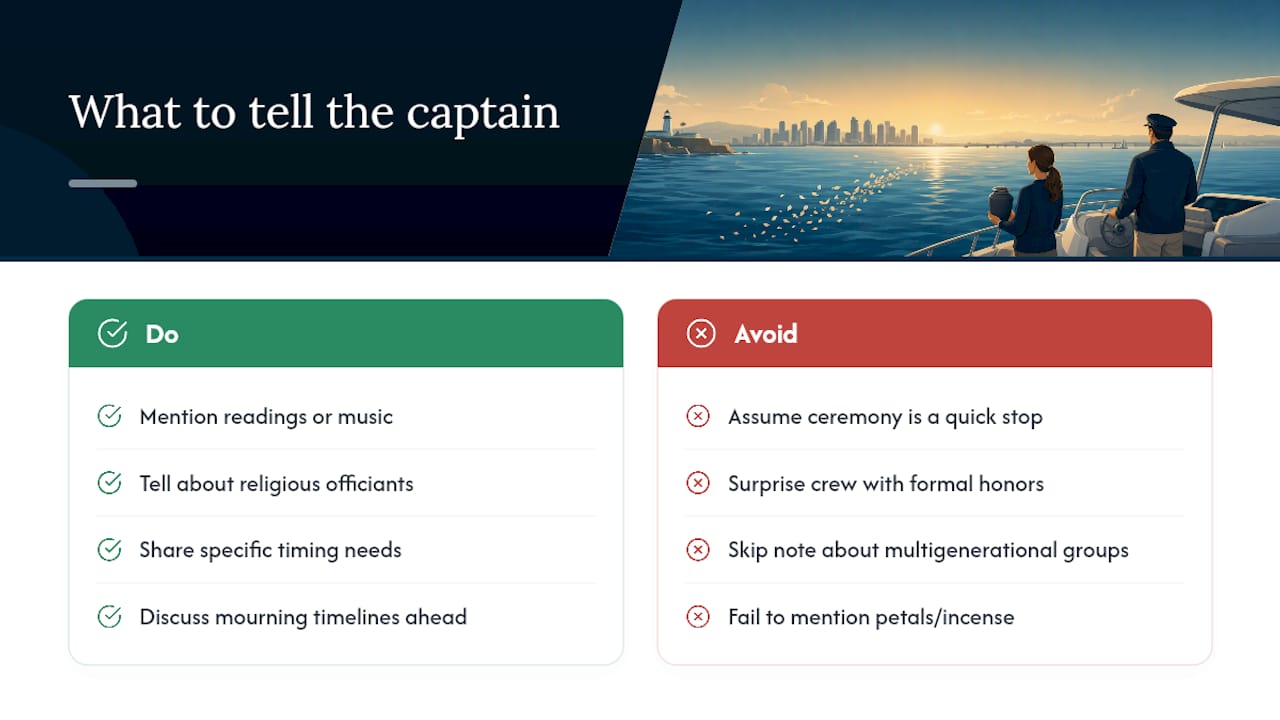
None of these customs require special permits beyond the standard VS-9, but they do affect planning. If your ceremony includes readings, music, specific timing, or religious officiants joining the trip, mention it when booking so the captain can plan the route and schedule around it rather than treating the ceremony as a simple pass-through stop.
Preparing Ashes: Urn Choices and Handling Before the Ceremony
Cremated remains typically arrive from the crematory in a plastic bag inside a temporary container or a simple urn, and that’s fine for transport, but it’s not what most families use for the actual scattering.
Biodegradable scattering urns, made from compressed sand, salt, gelatin, or paper pulp, are built specifically to dissolve in water within minutes to a few hours depending on the material and water conditions. These are the standard choice for at-sea ceremonies since they eliminate the need to retrieve anything afterward and they’re designed to release the ashes gradually rather than all at once.

Scattering tubes work differently: they’re paper or cardboard cylinders you pour directly from, giving the person doing the scattering more control over how and when the ashes leave the container. Some families prefer this for a hands-on moment; others prefer the urn’s slower, more ceremonial dissolve.
Handling matters more than people expect. Cremated remains are heavier and more granular than most people anticipate, closer to coarse sand than the fine ash the word suggests. If you’re transferring remains into a scattering urn or tube yourself, do it over a flat, stable surface indoors before the day of the ceremony, not on a moving boat deck.
If ashes need to be split, part for scattering and part for keeping, most funeral homes can handle that division before the ceremony and provide a smaller keepsake urn for the portion staying with the family. Bring whatever container you’re using to the dock in a bag or box that keeps it upright and sealed until the boat is out on open water.
Safety Basics for a Water or Onshore Ceremony
Wind and footing cause more problems during scattering ceremonies than almost anything else, and both are avoidable with a little planning.
On the water, the captain should position the vessel with the wind blowing away from guests before anyone opens an urn, never scattering into the wind. Guests should stay seated or hold a rail during the actual scattering moment, since boats shift even in calm water and an unexpected wobble at the wrong second is how accidents happen.
Life jackets should be accessible for every guest regardless of swimming ability, and any charter operator should walk your group through basic safety information before departure, not as an afterthought once you’re underway. Confirm the vessel’s certification meets Coast Guard passenger safety standards before booking, and don’t hesitate to ask directly rather than assuming.
Onshore, footing near tide pools, jetties, and rocky bluffs around Point Loma and Sunset Cliffs gets slick fast, and several of San Diego’s best viewing spots sit right along unstable coastal edges. Keep young children and elderly guests away from the immediate edge, and check tide tables before choosing a shore-viewing spot since rising tides can cut off return paths along some stretches of coastline.
Weather changes quickly on San Diego Bay, calm mornings can turn choppy by early afternoon, so confirm your operator’s cancellation and rescheduling policy for wind or swell conditions before the ceremony date, not on the morning of.
Captain Liz’s Note on Paperwork and Patience
Families call me most often not about the ceremony itself but about who’s supposed to file the paperwork. That confusion is avoidable. Confirm it in writing before the date, not the week after.
Weather is the other thing people underestimate. San Diego Bay can turn choppy fast, and rescheduling for a calmer morning is a kindness to your family, not a failure of planning.
— Captain Liz
Planning a Burial at Sea With Sterling Sails
Once the paperwork questions are settled, the ceremony itself deserves to feel personal rather than procedural. Sterling Sails handles burial-at-sea charters aboard Mojave with a private, USCG-certified captain, direct coordination on permits and timing, and GPS coordinates plus a memorial certificate delivered after the ceremony, all without sharing the boat with strangers or working around a public tour schedule.
When you call to book, ask about permit handling responsibility, available dates, how many guests the vessel accommodates, and any personalization you’d like included, music, readings, flower petals, or veteran honors. If your timeline is flexible, browsing the full range of sailing charter options can help you see how ceremony length and vessel time might fit around a larger family gathering that day. Reach out directly to check availability and start planning the date.
Where to Complete Official Permits and Filings
Three sources cover nearly everything you’ll need to file correctly:
-
San Diego County Office of Vital Records for the VS-9 permit itself, including fee and document requirements.
-
EPA Burial at Sea guidance for federal reporting rules and thresholds.
-
California State Parks scattering guidance for state-level location and handling rules.
Bookmark all three before your ceremony date so questions can be answered without a phone tag delay.
Sources
-
Burial Permits — San Diego County Office of Vital Records and Statistics
-
Burials at Sea – Scattering of Ashes — San Diego Maritime Museum
FAQ
Where Can You Scatter Ashes for Free in San Diego?
Open ocean water beyond the state’s offshore distance guidance doesn’t require paying for the location itself, though you’ll still need the county’s VS-9 permit and a vessel to get there, which typically means either your own boat or a paid charter.
How Much Does It Cost to Scatter Ashes at Sea in San Diego?
Unattended scattering services often start in the low hundreds of dollars, while private attended charters run mid-hundreds to low thousands depending on vessel and duration. Sterling Sails’ Burial at Sea charter starts from $950 per charter.
Where Can You Legally Scatter Ashes in California?
Open water, generally beyond the state’s 500-yard offshore guidance, is the legal standard statewide, since California prohibits scattering directly from beaches, piers, or boardwalks. Private property scattering requires the owner’s written permission, and park land often needs its own separate authorization.
How Much Does It Cost to Have Ashes Scattered?
Cost depends on whether family attends: unattended services in San Diego typically start in the low hundreds, while attended private charters run higher based on vessel size and ceremony length, usually 1.5 to 2 hours dock to dock.
Do You Need a Permit to Scatter Ashes in San Diego?
Yes. The county requires a Permit for Disposition (VS-9) for every scattering, on land or at sea, along with a verified statement filed within 10 days of the ceremony.