
Tip 10 to 20% of the base charter fee, and make 15% your default if you’re chartering under U.S. or Caribbean norms. Calculate that percentage against the charter fee alone, never the APA, VAT, fuel, or add-ons. Hand the gratuity to the captain in cash on the last evening of the trip, or arrange a wire or broker escrow ahead of time for larger yachts.
TL;DR:
- Tipping 10 to 15% of the base charter fee is standard in U.S. and Caribbean regions, with 15% being the typical default for most trips.
- The gratuity is handed to the captain in cash on the last night or morning and is then distributed among the crew according to the yacht’s internal sharing system.
- Larger crews result in smaller individual shares of the tip, even if the total tip amount increases with the overall crew size and the trip’s value.
- The tip should be calculated only on the base charter fee, excluding the APA, VAT, fuel, and other extras, to accurately reflect customary practice.
- Extra tips above 20% are appropriate only when the crew exceeds expectations significantly, while tips below 10% generally require prior discussion with the broker.
Table of Contents
- Tipping Yacht Charter Basics: What Different Percentages Signal
- Who Actually Gets Your Tip Money?
- When and How to Hand Over the Gratuity
- How Tipping Norms Shift by Region and Charter Type
- Doing the Math: Sample Tips at Common Charter Rates
- Exceptions: When to Tip More, Less, or Handle It Differently
- Captain Liz: Practical On-Deck Advice From a USCG-Certified Captain
- Why Most Tipping Advice Misses the Point
- Ready for Your Own Private Charter on San Diego Bay?
- Sources
- FAQ
Tipping Yacht Charter Basics: What Different Percentages Signal
A gratuity on a private charter isn’t a flat fee; it’s a message about the level of service you received, and crews read it that way.
- 5 to 10% signals the crew met basic expectations but something fell short, a late provisioning run, a stiff attitude, an itinerary that never quite came together.
- 10% flat works as a fair baseline, especially on a week-long Mediterranean charter where this is closer to the norm.
- 10 to 15% covers most solid, professional weeks. This is where the MYBA guideline lives, the industry body’s recommendation sitting at 5 to 15% of the base fee.
- 15 to 20% is the American and Caribbean standard for a crew that went out of its way, remembered your preferences without being asked, or handled a hiccup with grace.
- 20% or more is reserved for the rare charter where the crew genuinely changed how you feel about the trip.
American guests tend to land at the higher end of that range more often than European charterers, a pattern Nicholson Yachts attributes to tipping habits carried over from restaurants and hotels back home. On a $10,000 weekly charter, that gap corresponds to a significant difference in tip amounts at the low and high ends of the customary range. Neither is wrong. Both are read clearly by the crew.
Who Actually Gets Your Tip Money?
You hand the gratuity to the captain, and the captain distributes it. That’s the standard on nearly every crewed charter, and it exists for a good reason: crews already run on an internal system for splitting tips, and going around it creates friction that outlasts your trip.
Most yachts use a share or points structure. Senior crew, the captain, chief stew, chef, typically carry a heavier weight in the split. On a small boat with a two or three-person crew, differences are more pronounced. On a larger yacht with eight or ten crew members, the percentages flatten out because there are simply more people dividing the same pool.
- The captain collects the pooled tip and applies the boat’s own distribution rules.
- Larger crews mean smaller individual shares even when your total tip is generous.
- A quiet, separate thank-you gift to one crew member (a sealed envelope, a small personal note) is fine, but keep it discreet so it doesn’t undercut the pool system.
Pro Tip: If one crew member went far beyond their role, a $20 to $40 personal envelope handed privately says thank you without disrupting how the main gratuity gets split.
When and How to Hand Over the Gratuity
Timing and method matter almost as much as the amount. Get this wrong and an otherwise generous tip can feel awkward for everyone involved.
- Prepare the envelope before the final evening. Count and seal the cash ahead of time so the handoff isn’t fumbled at disembarkation.
- Present it on the last night or morning of departure, directly to the captain, with a short word of thanks.
- Use U.S. dollars or the local currency, whichever the broker recommends. Skip coins entirely, and never offer a personal check.
- For large charters, ask your broker about wire transfer or escrow before the trip starts. Some brokers hold tip funds in escrow and release them to the crew after the charter, which sidesteps the challenge of carrying thousands in cash through customs.
- Confirm currency and cash-limit rules for your destination early. International cash thresholds vary, and nobody wants a customs conversation on vacation.
Cash to the captain remains the default across the industry, but wire transfers are increasingly common on larger yachts specifically because they remove the logistics headache.
How Tipping Norms Shift by Region and Charter Type
Where you sail changes what’s typical, and pretending otherwise is how well-meaning guests either overtip awkwardly or undertip without realizing it.
- Mediterranean charters run closer to 10 to 15%, consistent with European service-tipping culture generally.
- Caribbean and U.S. charters trend higher, 15 to 20%, shaped by American tipping norms and often by larger, more attentive crew-to-guest ratios.
- Day charters follow a similar percentage logic, 10 to 20% of the day rate, with 15% the common middle ground.
- Crew size matters as much as destination. A two-person crew running a day charter divides your tip very differently than an eight-person crew on a weekly Caribbean sail.
- Bigger yachts often mean bigger tips in dollar terms, even at the same percentage, simply because the base charter fee is higher.
None of these are rigid rules. They’re starting points that adjust based on how the week actually went, and a great crew on a modest boat still deserves the upper end of the range.
Doing the Math: Sample Tips at Common Charter Rates
Once you know your percentage, the arithmetic is simple, as long as you’re calculating against the right number. That number is the base charter fee only. Leave out the APA (the advance provisioning allowance that covers fuel, food, and dockage), VAT, and any optional extras. Tipping on those inflates your gratuity well past what’s customary.
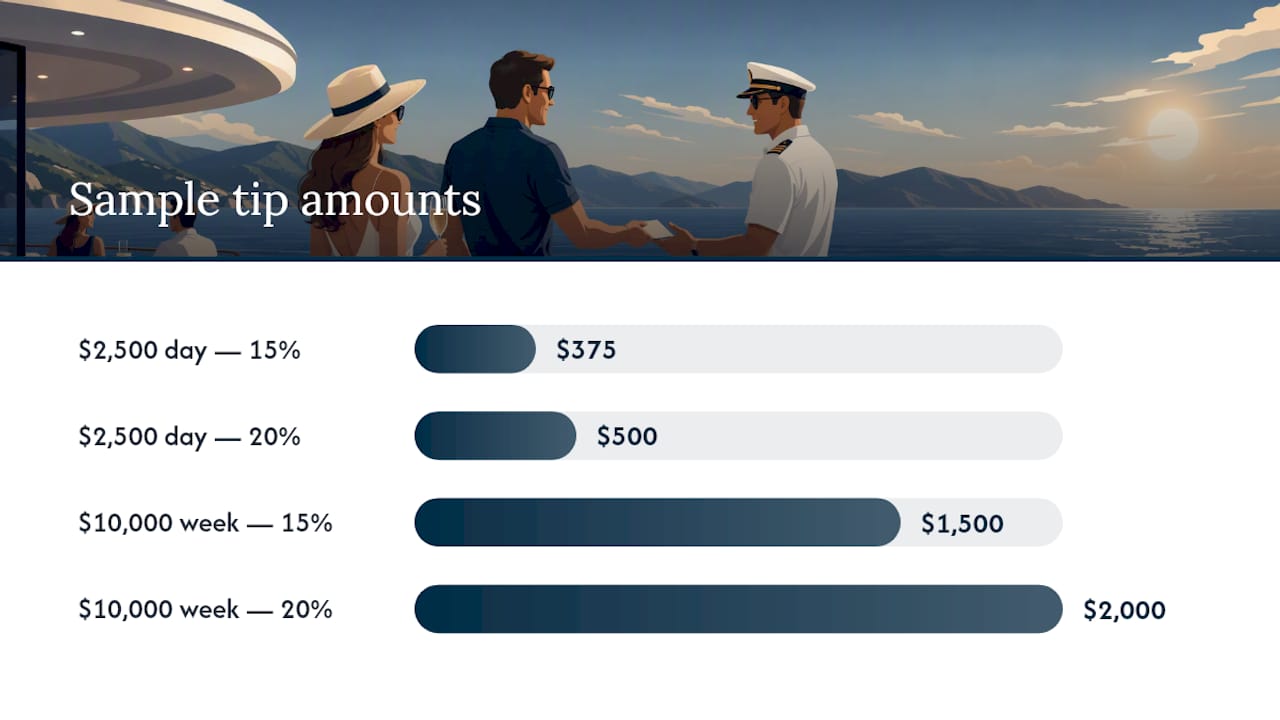
A day charter at $2,500 and a strong crew earns a $375 to $500 tip at the 15 to 20% band typical for day-charter tipping. A $10,000 weekly Caribbean charter with a crew that nailed every request comfortably lands at $1,500 to $2,000, not $1,000, because 10% undersells what the MYBA baseline treats as a floor rather than a target.
Exceptions: When to Tip More, Less, or Handle It Differently
Good judgment beats a rigid formula here, and a few situations call for a different approach than the standard range.
- Tip below 10% only after raising the issue with your broker before the trip ends, not by silently shorting the crew and saying nothing.
- Tip above 20% when the crew solved a real problem, a broken generator, a storm reroute, a special request they pulled off flawlessly.
- Check your contract for an included service charge. If one exists, confirm with your broker whether it already reaches the crew before adding more, a point covered in most charter terms and conditions.
- If a crew member hints at expecting a specific amount, treat that as a red flag. Solicitation isn’t standard practice and is worth mentioning to your broker.
- For dock staff or fuel dock helpers, a small $10 to $20 cash tip is a courteous, low-stakes gesture separate from the crew gratuity.
Captain Liz: Practical On-Deck Advice From a USCG-Certified Captain
After years on the water, I’ve watched guests overthink this moment far more than they need to. Here’s what actually works: hand the envelope to the captain, look them in the eye, and say something like, “For the crew, thank you for a wonderful trip.” That’s it. No math explanation required.
The biggest guest mistake I see is waiting until the very last second, sometimes literally on the dock with bags in hand, when a calmer moment the evening before serves everyone better. Curious how a private charter runs from start to finish? Our blog covers the details, and you can read more about my background as owner and captain.
Why Most Tipping Advice Misses the Point
Most guides treat tipping like a math problem with one correct answer. It isn’t. The MYBA range of 5 to 15% exists as an industry floor, not a script, and the real judgment call is reading your own week honestly. Did the crew just execute the itinerary, or did they anticipate what you needed before you asked?
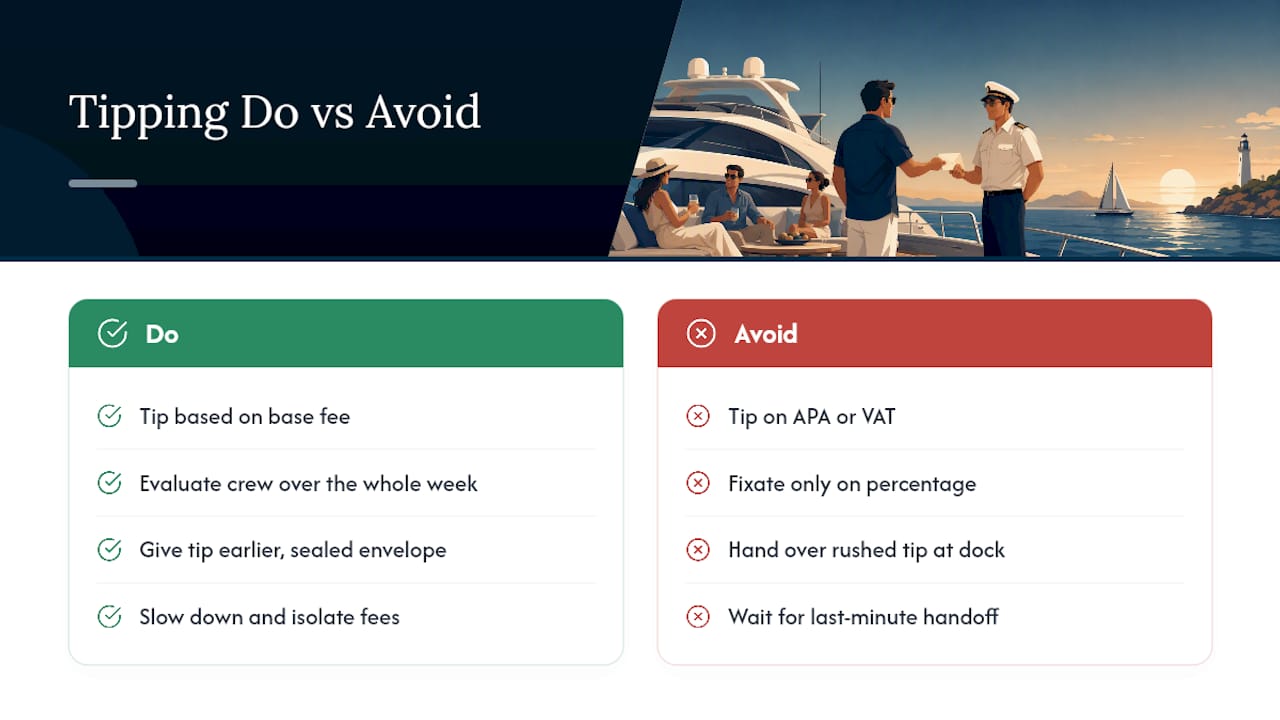
Where conventional advice falls short is timing. Guests fixate on the percentage and forget that a fumbled, last-minute handoff can undercut even a generous tip. A calm word and a sealed envelope the evening before beats a rushed exchange at the dock every time.
If you take one thing from this guide, prioritize the base fee calculation over everything else. Tipping on the APA or VAT by mistake is the single most common overpayment I’ve seen guests make, and it happens because those numbers sit right next to the charter fee on the invoice, easy to lump together in a hurry. Slow down, isolate the base fee, then decide your percentage.
— Captain Liz
Ready for Your Own Private Charter on San Diego Bay?
Every charter is fully private, no shared decks, no strangers, just your group aboard a classic 42-foot yacht with a certified captain at the helm and complimentary champagne poured before you’ve even left the marina.
Whether you’re picturing a golden-hour sunset cruise, a lively bachelorette celebration, or a proposal you want captured perfectly on the water, the boat and the itinerary bend around your occasion, not the other way around. Browse the full range of sailing adventures and pick your date. San Diego Bay looks different from a private deck, and there’s no better way to see it for yourself.
Sources
For deeper regional detail, Yacht Crew Gratuity by Region breaks down MYBA norms by destination. Nicholson Yachts covers broader charter etiquette. For day-trip specifics, see Day Charter Tipping, and for a general charterer’s reference, How to Tip Yacht Crew.
- Yacht Crew Gratuity by Region: How Much to Tip in 2026
- How to Tip Yacht Crew: The 2026 Guide for Charterers
FAQ
How much should I tip the captain of a charter boat?
Tip 10 to 20% of the base charter fee, with 15% a common default for U.S. and Caribbean charters. Hand the full amount to the captain, who then distributes it among the crew according to the yacht’s own share system.
What is the 10% rule for yachts?
The “10% rule” refers to using 10% of the base charter fee as a conservative baseline gratuity, a figure drawn from the MYBA guideline of 5 to 15%. It’s a floor for average service, not a ceiling for a crew that went above and beyond.
Do yacht crew get paid a salary, or do they rely on tips?
Yacht crew earn a regular salary from the yacht owner or management company; gratuities are a separate reward for exceptional guest service, not a replacement for wages. That said, tips make up a meaningful part of seasonal income for many charter crews, which is part of why the MYBA guideline exists as an industry standard.
Does Sterling Sails include gratuity in the charter price?
Gratuity for the captain isn’t built into the listed charter price and is left to guest discretion, consistent with common charter industry practice. Details on booking terms are available in the terms and conditions, and current pricing for each charter is listed on the sailing adventures page.
Should I tip differently for a day charter versus a week-long charter?
A week-long charter with a larger crew divides that same percentage among more people, which is why total crew size is worth factoring into your final decision.